Full name
Jan. 11th, 2022
◆
5 min read
If you need to find investors for a company or a property, crowdfunding platforms deserve a serious look. According to ESMA, 181 licensed platforms in 21 EU Member States raised €4.25 billion in 2024. Startups raise there from customers and fans who already use the product and want a stake in it. For a founder with an established business, a crowd-investment round can bring in growth capital without giving one large investor a board seat. A family office financing a real estate project can open part of the round to private investors rather than carry the full ticket itself and start refinancing their own projects earlier.
Companies that are larger and already have traction can go a step further and run the fundraising themselves. NYALA's easyRaise package gives issuers a white-label investor portal with KYC, payments, wallets and custody included. The MiFID II securities are registered with a BaFin-supervised crypto securities registrar and distributed through a liability umbrella. A raise can go from decision to launch within days. Whichever route a company takes, the round can only be as large as the investor base behind it.
A crowd-investing platform can only place a deal with the investors it already has. Say a strong company wants to raise €3 million, and your recent rounds closed at around €600,000. You can turn the issuer away, or take on a raise you may not fill. It can very well be that the ideal investors for a particular company are not part of that platform’s profile. So the question becomes how do you find investors outside your own user base, but both in your home market and in other parts of Europe?
Below we look at the limits platforms run into, using the latest market data. Then we explain how NYALA's Co-Listing Network lets several platforms in different EU markets promote the same offering at the same time.
Where crowdinvesting platforms hit a ceiling
According to ESMA's crowdfunding market report published in December 2025, 181 authorised crowdfunding service providers in 21 Member States raised €4.25 billion in 2024. Per deal, the numbers are much smaller. Retail investors make up 88% of the investor base and put in around €660 each on average. Close to half of all projects (46%) raised less than €1 million.
Lets run the math on a €2 million round. At €660 per retail investor, a platform needs roughly 3,000 people to commit to a single offering. A platform with 20,000 registered users can manage that a few times a year. It cannot do it every month, and it cannot do it for every good company that asks.
Investors stay close to home
With the inception of the European Crowdfunding Service Providers Regulation, a platform authorised in one Member State can serve investors across the whole EU (after prior notification to their national competent authority). In practice however, investors still invest locally. ESMA found that, on average across providers, only 8% of the funding raised in 2024 came from investors residing in a different country.
The reasons are practical. Marketing communication rules and language requirements still differ between Member States, a point the European Digital Finance Association raised in its September 2025 position paper on ECSP. Investors also prefer brands they know, documents in their own language and a customer support in their domestic language. For a platform, a second market means translation, local marketing, local partners and local support before the first euro comes in.
Larger issuers go elsewhere
The legal room for bigger rounds exists. ECSP allows offers of up to €5 million per project owner within 12 months, and the same EDFA paper notes that few campaigns reach that cap. Where platforms therefore run short is investor reach.
If an issuer needs a €3 million round, but the crowdinvesting platform’s largest round tapped out at €800.000, it becomes unlikely, that the issuer will choose to work together with the investment platform.
The platform loses the deal, and its investors lose access to a more established issuer.
Deal flow is the other half of the problem
Platforms also need a steady supply of good assets. Investors who find nothing new for two or three months start looking at other platforms. For a small team, each new offering means weeks of work on due diligence, documentation and issuer onboarding.
So the platform with spare investor demand and the platform with spare deals often sit in different countries and never meet.
How NYALA Co-Listing helps platforms find investors across the EU
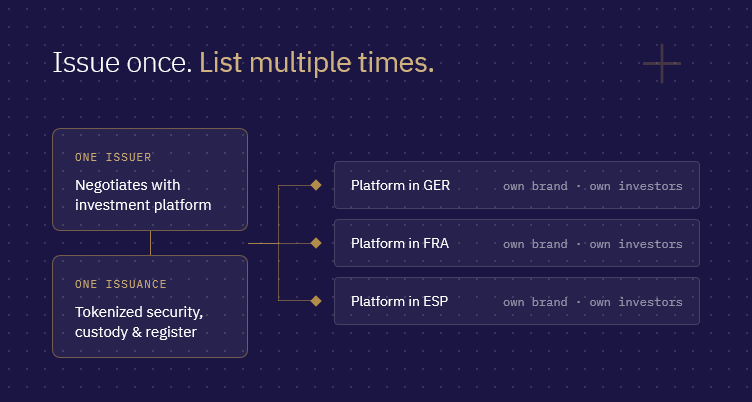
NYALA's Co-Listing Network lets one offering be listed on several investment platforms in several EU markets at the same time. Each platform presents the offering to its own investors under its own brand, while the security itself is issued once and recorded in one register. The network, which is already live, can already boast itself with a combined investor base of more than 270,000 investors.
A co-listed offering runs in six steps:
What co-listing changes for each side
For the platform that sourced the deal
You can say yes to larger issuers. A €3 million round becomes a realistic target when three or four platforms each place part of it. You keep the issuer relationship, and several investor bases can subscribe in parallel rather than one after another.
For co-listing platforms
You get access to vetted offerings without building your own origination team. Your investors have something new to look at between your own deals, you earn a commission on the volume they subscribe, and your customer data stays with you.
For issuers
One process reaches investors in several markets. The issuer works with one originating platform and one registered security, and does not need to negotiate a separate listing in each country.
For investors
Investors see offerings from other EU markets on a platform they already use, with the onboarding and support they know. They can invest into opportunities from other member states without opening an account abroad.
Looking for investors for your next offering?
Some platforms have deals that are too large for their own investor base. Others have investors who need more projects to invest in. Co-Listing connects the two, across borders and without either side giving up its customers.
See how the Co-Listing Network works or talk to our team. Developers can find the technical overview in our developer documentation.
Sources: ESMA Market Report: Crowdfunding in the EU 2025 (December 2025, data for 2024); EDFA position paper on ECSP (September 2025); Regulation (EU) 2020/1503, Article 1(2)(c)
Book a call with our expert.