Full name
Jan. 11th, 2022
◆
5 min read
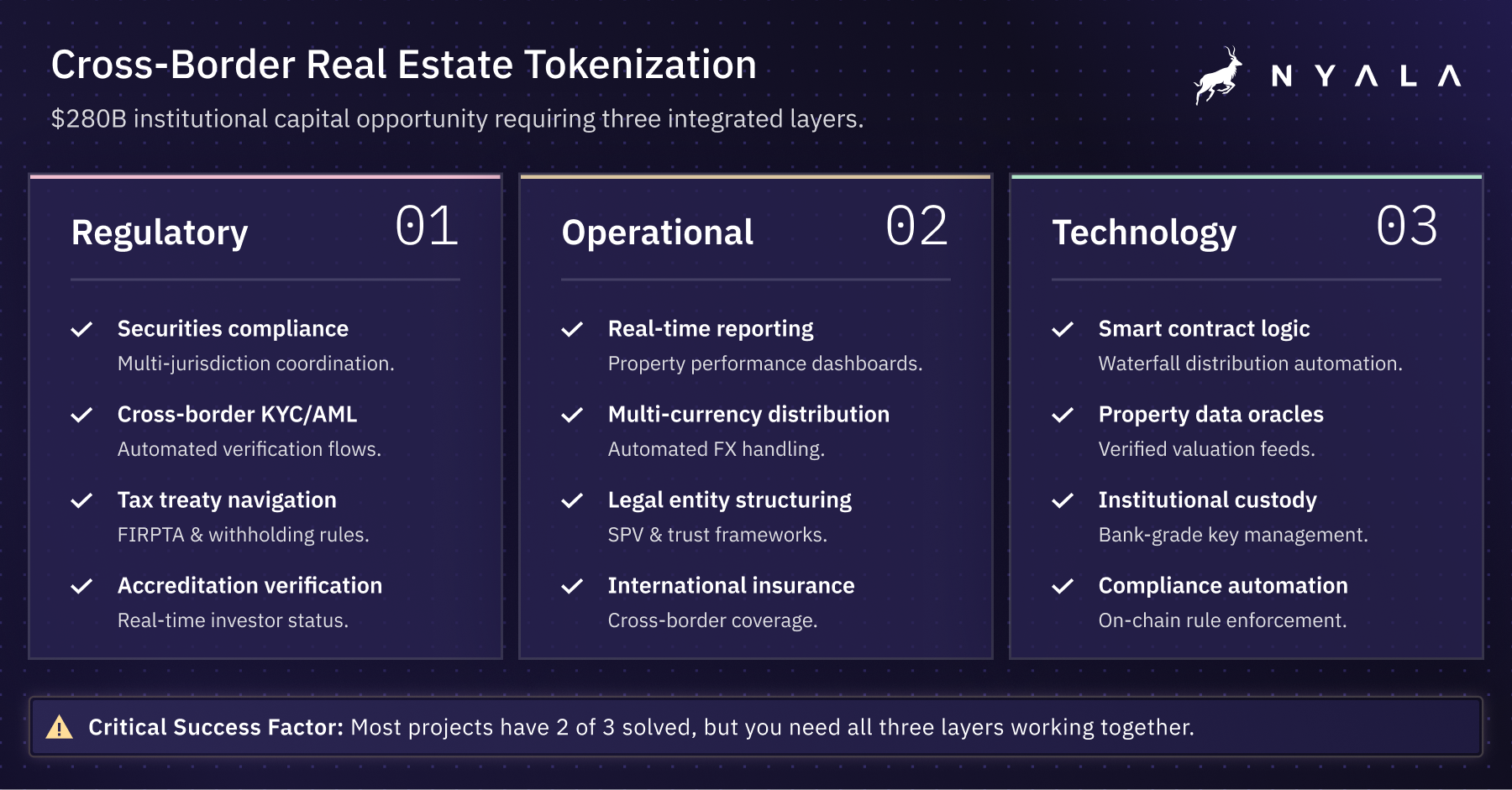
The idea of a cross‑border tokenized commercial real estate (CRE) market often comes with large numbers attached. One frequently cited scenario imagines roughly 280 billion dollars in potential institutional participation if even a fraction of global real‑estate portfolios adopt tokenized structures. The figure should be read as a directional estimate, illustrating the possible scale if adoption expands.
Scaling tokenized CRE depends on alignment across three layers: compliance that endures through the full lifecycle, operations that can run distributions and quarter‑end closes without manual fixes, and technology that connects cleanly to both through lifecycle logic, auditable controls, traceable ownership history, and credible exit mechanics.
Cross‑border tokenized CRE becomes sustainable only when three systems work together: regulatory, operational, and technological. Each supports the others and together they form the base infrastructure.
Regulatory layer – compliance as a continuous process
Cross‑border structures depend on consistent, ongoing compliance. Key elements include:
Offering structures that remain within securities regulations such as Regulation A or D.
Investor eligibility and accreditation workflows that meet standards across jurisdictions.
AML and KYC frameworks that satisfy both issuer and investor requirements.
Tax handling for non‑U.S. investors, including FIRPTA withholding obligations for exposure to U.S. real property interests.
Compliance is not a one‑time checklist at launch. It becomes part of the daily operating system, as eligibility, transfer restrictions, reporting, and tax outputs all interact throughout the asset’s life.
Operational layer – from issuance to execution
Tokenization only becomes meaningful when the operational engine works reliably. Key priorities include:
Steady data and reporting flows from property managers.
Distribution mechanisms that manage multiple currencies and withholding automatically.
Legal structures that support governance, liability separation, and investor protection.
Data and disclosure routines that meet jurisdictional standards.
The key question is simple: can the system reproduce a full quarter‑end close using its own data, without manual reconstruction?
Technology layer – integration creates value
Technology matters when it connects cleanly to regulatory and operational frameworks. Effective platforms usually share three traits:
Smart contracts that understand lifecycle logic for distributions and performance tiers.
Data oracles with defined responsibilities and verifiable attestations.
Custody and control frameworks that align with institutional audit and approval requirements.
Compliance tools based on verified identity rather than only wallet addresses.
Distributed ledger technology (DLT) reduces reconciliation costs when several parties share responsibilities. It improves accuracy for ownership records, lifecycle events, and audit trails.
Yet DLT alone does not solve investor acquisition, tax complexity, or property performance risks. If the off‑chain infrastructure is weak, tokenization only increases the number of things that can go wrong.
The critical question for institutions is whether exit mechanisms will mature before investors expect liquidity.
Transferability does not equal liquidity. Markets require compliant venues, stable pricing, and predictable settlement. Secondary markets follow the same alignment logic: regulatory clarity, operational readiness, and integrated technology. In most cases, “secondary” readiness means first mastering consistent post‑trade servicing.
A few simple checks reveal whether a system is ready for scale:
State model: Can subscriptions, allocations, and distributions be reconstructed from one event log?
Control model: Are approvals traceable and auditable under clear segregation of duties?
Data model: Which off‑chain reports are authoritative, and how are discrepancies resolved?
If any of these questions cannot be answered confidently, the platform is still a prototype.
Cross‑border tokenized CRE will likely evolve gradually rather than suddenly. Progress will follow where regulation, operations, and technology move in sync. The real opportunity lies in turning pilot logic into infrastructure that works reliably, every day.
Book a call with our expert.