Blog
Academy

Servicing at scale: Why EU crowdfunding is won in operations, not at issuance

This article offers a practical framework for teams scaling under ECSPR. Use it to build sustainable processes.
Crowdfunding advice for scale

Executive Summary

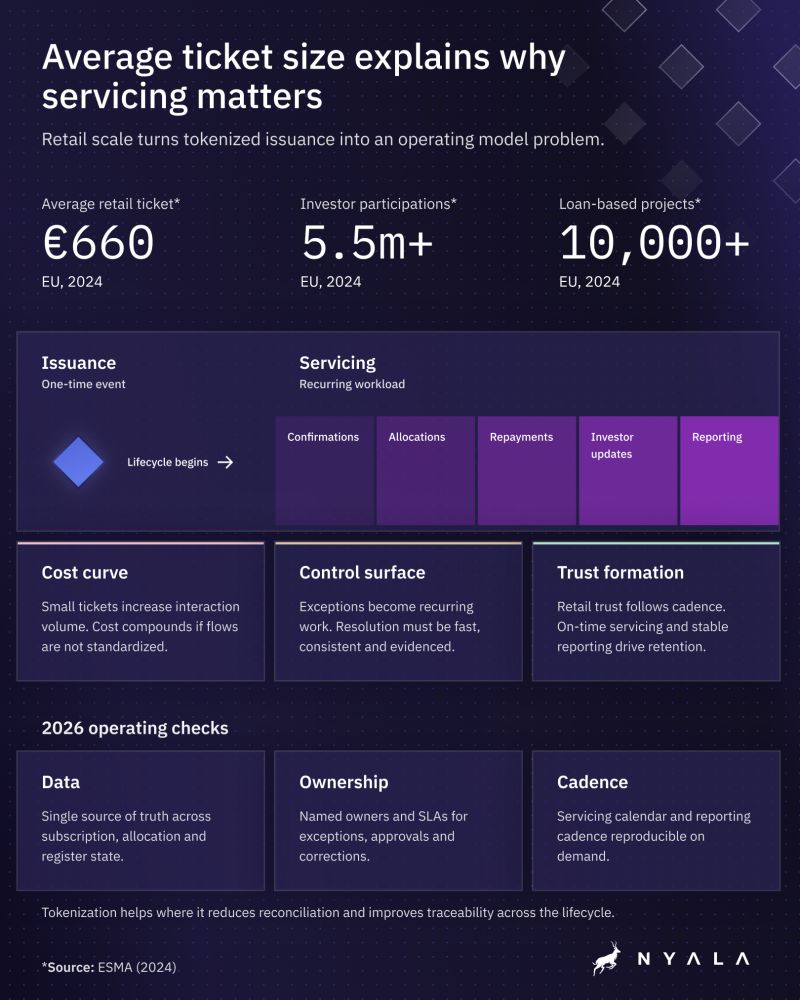
EU crowdfunding is a retail scale market by design. This determines the operating model. ESMA 2024 data shows many investors, small average tickets, and a large number of projects. The main scaling constraint is not structuring or launching an issuance. It is full lifecycle execution: allocations, repayments, investor communications, reporting, and exception handling.

1. The market parameters that define operating reality

ESMA's 2024 dataset covers 181 authorized providers across 21 Member States and EUR 4.25 billion in volume. Key inputs for your platform design:

  1. 88 percent of investors classified as retail
  2. Average retail investment around EUR 660
  3. More than 5.5 million investor participations
  4. Over 10,000 loan based projects in 2024
  5. Loans as dominant instrument class (58 percent of total volume)

2. Issuance is a step, servicing is the system

In high volume retail markets, costs accumulate after issuance. Focus your roadmap here:

  1. Confirmation and allocation workflows
  2. Repayment execution and payment matching
  3. Investor communication and periodic reporting
  4. Amendments, corrections, and support cases

Small failure rates (1 percent) become material across millions of participations. Prioritize operating model over perfect issuance mechanics.

3. Exceptions are predictable at scale

Platforms lose time on manual interventions, not happy path execution. Categorize exceptions where system state diverges:

  1. Subscription versus cash: late, partial, unmatched payments, refunds
  2. Cash versus allocation: caps, cancellations, late compliance flags
  3. Allocation versus register state: manual writes, corrections, disputes
  4. Register state versus reporting: outputs not reproducible from event history

Your goal: Cut resolution time from days to hours. Track exceptions per 1,000 investors to prioritize fixes.

4. Trust as an operational output

Retail investors care about execution consistency:

  1. Repayments arrive on time
  2. Reporting follows stable cadence
  3. Communications stay clear during changes
  4. Issues resolve transparently and quickly

Build trust through operations: Predictable cadence cuts support tickets by 30-50 percent. Uncertainty drives churn.

5. Where Decentralized Ledger Technology (DLT) helps and where it does not

DLT delivers real workload reduction where reconciliation costs recur:

  1. Time ordered event history for register actions
  2. Non repudiable records of approvals and servicing
  3. Traceability from subscription to allocation to register
  4. Fast entitlement reconstruction at record dates

DLT cannot solve:

  1. Distribution or customer acquisition
  2. Local trust building
  3. Identity verification or suitability checks

Focus DLT spend on shared state problems between parties.

6. A minimal framework for scaling lifecycle operations

Three steps to constrain variance and cut manual work:

Step 1: Define system of record
Set what is canonical for identity, subscriptions, allocations, register state.

Step 2: Derive register from events
Treat allocations as event streams. Link via stable IDs: subscription → cash → allocation → register.

Step 3: Operationalize exceptions
Categories → ownership → SLAs. Measure rate per 1,000 investors, resolution time by type.

7. Your 2026 checklist

Answer these three questions before planning:

  1. One source of truth from subscription to register?
  2. Clear ownership and SLAs for every exception category?
  3. Can you reproduce servicing calendar and reporting on demand?

Platforms solving these basics will handle ESMA's retail scale reality. Servicing is your competitive moat.

Share this post

Discover NYALA's tailored solutions for tokenizing your assets

Book a call with our expert.

Photo of Celina Homps

Celina Homps

Business Development Manager
c.homps@nyala.de